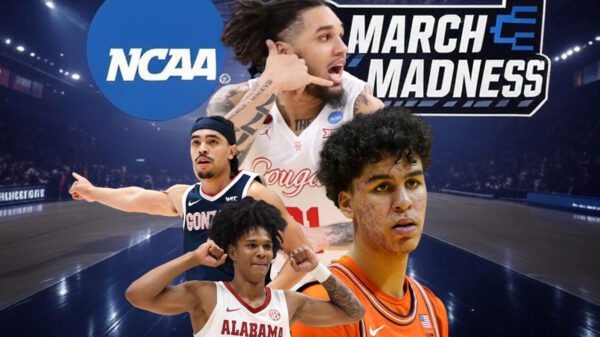










































The NCAA no longer resembles the amateur model it once sold to the public.
With NIL collectives operating like marketing agencies, the transfer portal reshaping rosters overnight, and former professionals reclaiming eligibility, Division I basketball has evolved into something far closer to a developmental pro league. Yet amid all the structural change, one constant remains: Canada’s footprint continues to expand.
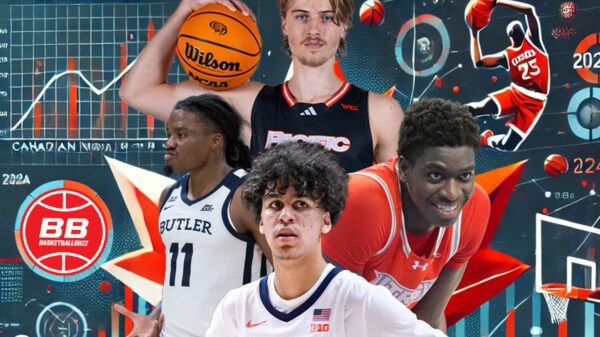
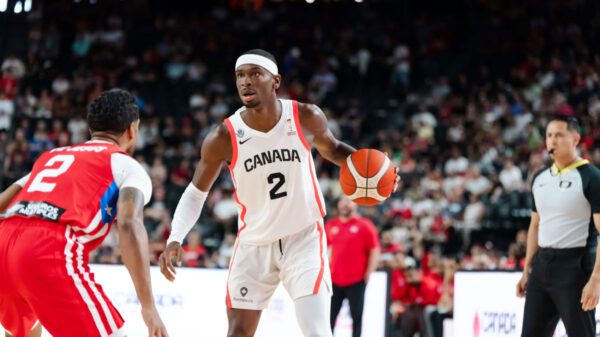
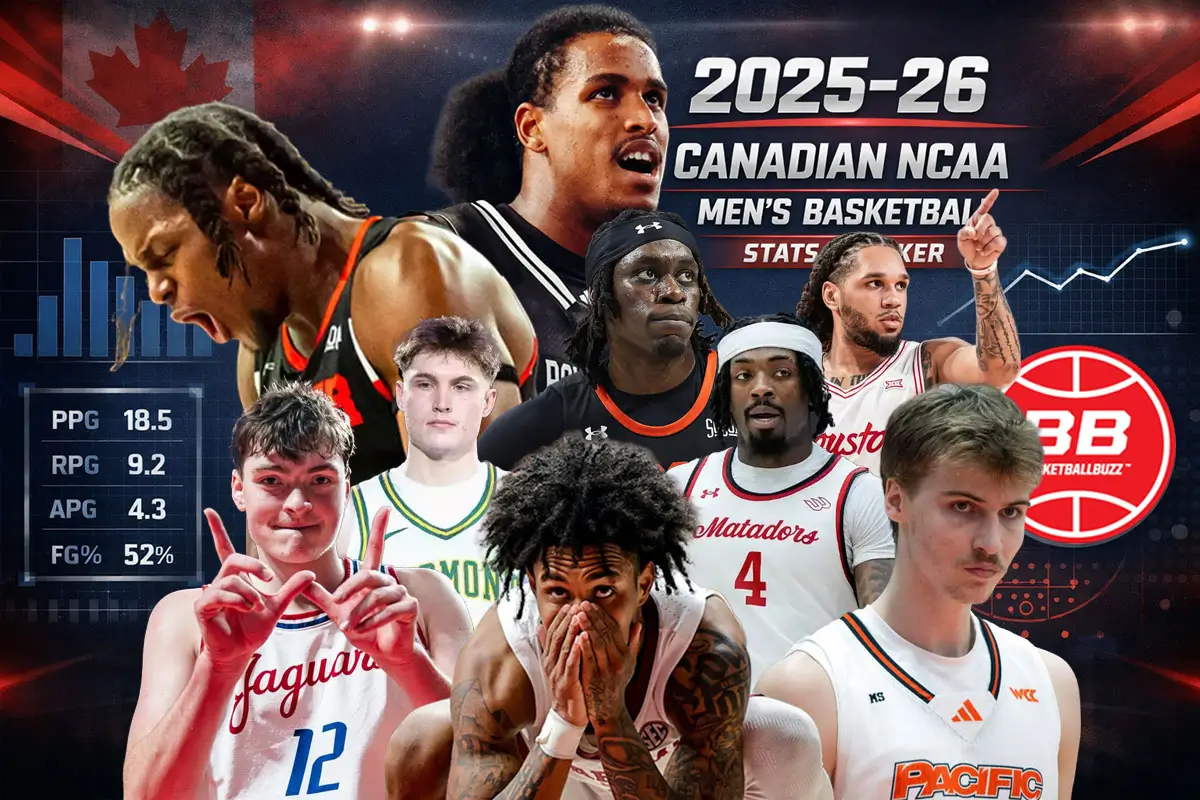
For the fifth consecutive season, Canada leads all international countries with 168 players competing in Division I men’s basketball. The number reflects depth, but this year’s story is less about a singular lottery-bound headline and more about distributed production across the country.
Unlike recent seasons, there is no consensus Canadian projected in the first round of the 2026 NBA Draft. If that holds, it would snap a five-year streak of first-round selections. Still, Canadians have been drafted in 15 of the past 16 years dating back to 2010, with the lone exception coming during the COVID-altered 2020 cycle. Draft positioning has fluctuated. The development pipeline has not.
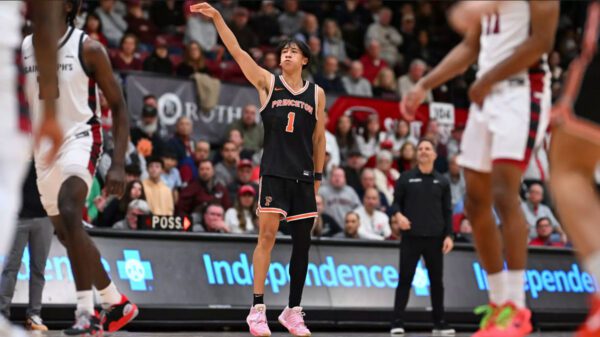
Yet if one Canadian carries the clearest draft swing potential, it may be Florida guard Xaivian Lee.
One of the most compelling off-season story lines unfolded when Lee transferred from Princeton to Florida and signed a multi-year endorsement agreement with Serious Players Only — a lucrative NIL partnership reportedly structured around the possibility of a future signature shoe should he reach the NBA. The move reflected more than opportunity. It signaled market belief.
Now averaging 11.0 points, 3.7 rebounds, and 4.1 assists, Lee brings experience and poise to a Florida program with back-to-back championship ambitions. He joins an exclusive group of Canadians to surpass 1,500 career points, 500 rebounds, and 400 assists at the Division I level — a statistical threshold that underscores both durability and offensive versatility.
In the NIL era, production and visibility often move in tandem. Should Florida make another deep March run, Lee’s profile could rise just as quickly as his draft stock.
And the production driving Canada’s broader pipeline is undeniable.
2025-26 Canadian NCAA men’s basketball stats tracker – Total minutes vs. assists, steals, turnovers (subscribers only)

Canadian point guards once again control tempo across the NCAA landscape. Yet no Canadian has imposed himself offensively quite like Mercer’s Baraka Okjie.
Ranking among the country’s scoring leaders, Okjie currently leads the NCAA in total free throws made and attempted — a testament to relentless rim pressure and sustained offensive responsibility. The six-foot-three guard from Brampton, Ontario is on pace to become just the second Canadian in Division I history to average at least 19.5 points and 5 assists in a season, a benchmark not reached since Steve Nash accomplished the feat at Santa Clara in 1994–95. Okjie’s downhill force, shot creation, and playmaking versatility illustrate the modern Canadian archetype — skilled, assertive, and adaptable.
Elsewhere in the backcourt, high-level playmaking continues to define the national identity. At Cal State Northridge, Josiah Davis is delivering one of the most productive distributing seasons by a Canadian in recent memory, averaging 15.9 points and 7.4 assists while surpassing 200 total assists. At Pacific, Jaden Clayton has climbed past 600 career assists while averaging 6.3 per game, placing himself among the most accomplished Canadian playmakers in NCAA history. In an era defined by roster volatility, their sustained command underscores developmental stability.
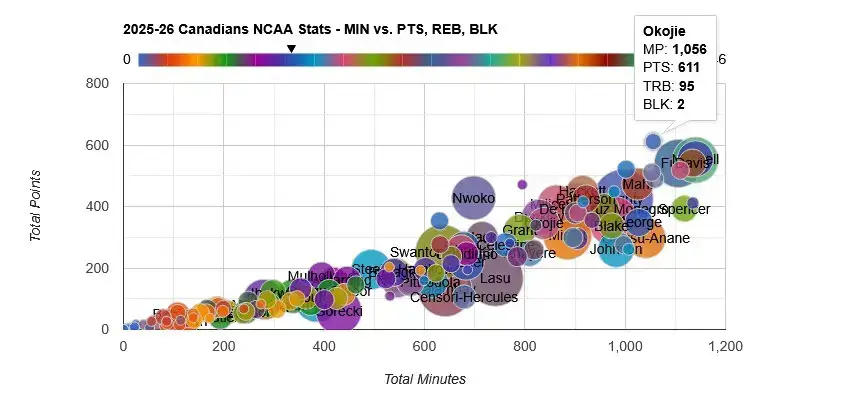
2025-26 Canadian NCAA men’s basketball stats tracker – Total minutes vs. points, rebounds, blocks (subscribers only)
Interior presence remains equally authoritative. St. Bonaventure’s Frank Mitchell is authoring another double-double campaign, averaging over 16.3 points and 10.1 rebounds while approaching 800 career boards in fewer than 90 appearances. Mercer’s Armani Mighty has mirrored that consistency with 13.2 points and 10.5 rebounds per game, positioning both among national leaders in double-doubles. For a country once labeled guard-heavy, Canada’s frontcourt production has become just as imposing.
Perimeter efficiency has reached historic territory as well. South Alabama’s Adam Olson eclipsed the 100-made three-point mark this season while finishing with over 518 total points — placing him just behind Okjie among Canadian scoring leaders. Houston’s Emanuel Sharp continues his climb up the all-time Canadian three-point leaderboard, threatening long-standing career marks with his blend of volume and range.
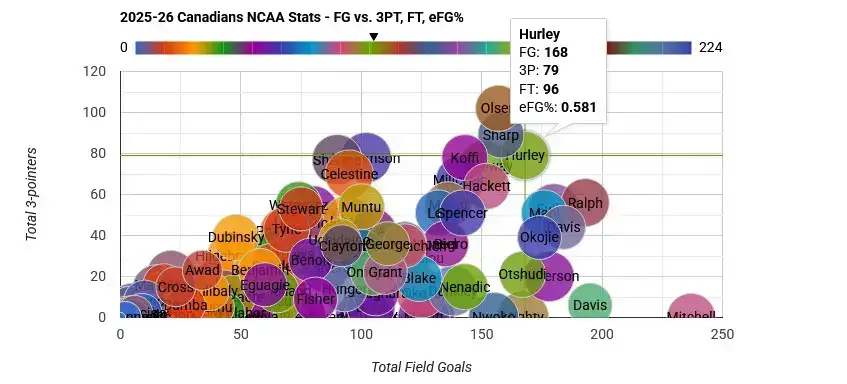
Meanwhile, Vermont’s TJ Hurley has converted more than 91% percent of his free-throw attempts on significant volume, producing one of the most efficient foul-line resumes ever recorded by a Canadian at the Division I level. Over 124 career games, Hurley has gone 270-for-300 from the line (90% percent), missing just 30 attempts for the Catamounts while establishing himself as one of the most reliable shooters in the country.
2025-26 Canadian NCAA men’s basketball stats tracker – Total FG vs. 3PT, FT, eFG% (subscribers only)
Single-game brilliance has also left its mark. Saint Louis guard Ishan Sharma delivered one of the most efficient shooting performances by a Canadian in Division I history, knocking down 9-of-12 three-point attempts in a 29-point outing against St. Bonaventure. The nine made threes rank as the second-highest single-game total ever recorded by a Canadian at this level, placing Sharma in rare statistical company and reinforcing the continued evolution of Canadian perimeter scoring.
Yet perhaps the most intriguing structural shift lies in the growing impact of U Sports transfers.
For decades, the pathway from Canadian university basketball to the NCAA — and especially to the NBA Draft — felt distant. Not since William Njoku was selected by the Indiana Pacers in 1994 has a Canadian with prior U Sports experience heard his name called on draft night.
That bridge may be reopening.
South Alabama’s Adam Olson, who began his collegiate career at UBC, has emerged as one of the clearest examples of that shift. Named Second-Team All–Sun Belt, Olson averaged 16.7 points per game while leading the conference with 99 made three-pointers, tying a program single-season record set in 2002. He ranked 17th nationally in threes per game (3.30), and his 39.1 percent shooting from beyond the arc led the Sun Belt and ranked 59th nationally.
Olson has translated seamlessly from U Sports to Division I, finishing among the top Canadian scorers in the country. His production is not a novelty — it is evidence.
2025-26 Canadian NCAA men’s basketball stats tracker – per game (subscribers only)
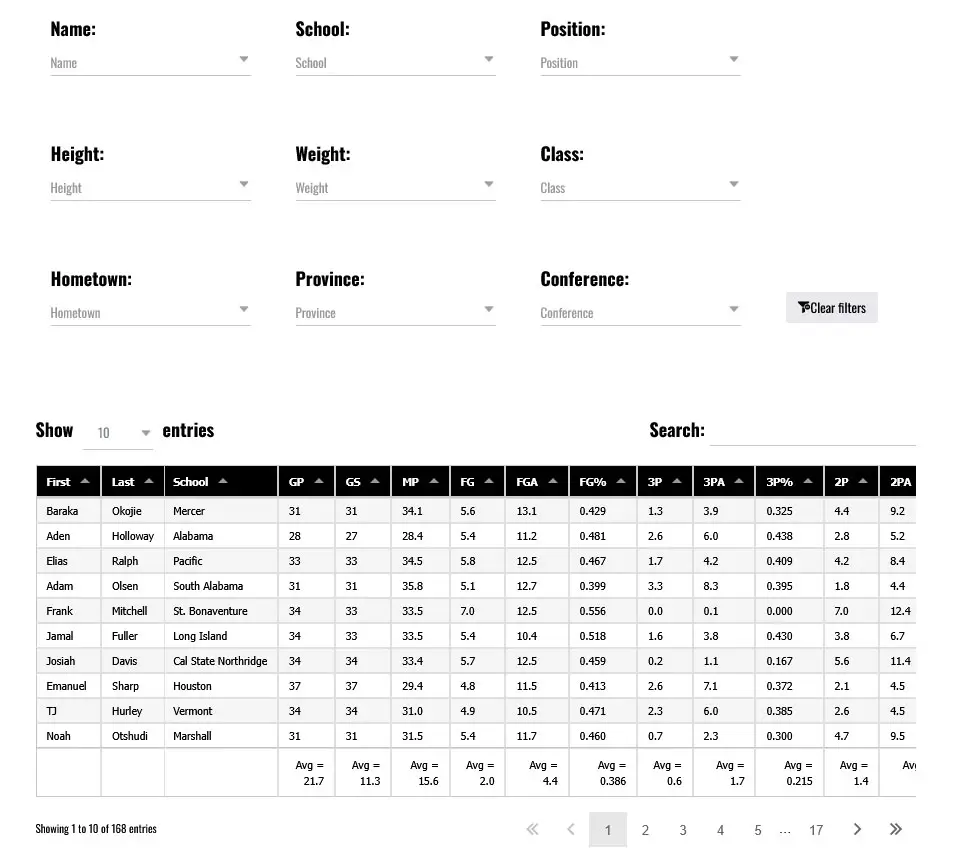
Former Victoria standout Elias Ralph has reinforced that momentum, earning All-Conference First Team honors after averaging 16.7 points and 6.7 rebounds with nine double-doubles. Ralph ranked among West Coast Conference leaders in scoring, rebounding, efficiency, and minutes, solidifying his place among the most impactful Canadians in Division I this season.
In just two seasons at Pacific, Ralph has already surpassed 1,000 career points, becoming the first two-year player in program history to reach that milestone. The last Tiger to score 1,000 points across any two-season span was Dell Demps (1988–92), who combined for 1,026 points during the 1990–91 and 1991–92 campaigns.
The momentum extends across multiple programs. At UMass Lowell, former Carleton guard Xavier Spencer averaged 11.7 points, 4.4 rebounds and 2.8 assists across 31 starts, providing versatility and structure in a primary role.
Dezayne Mingo, now at Charlotte after beginning his collegiate career at Guelph, delivered 11.8 points, 4.5 assists and 3.3 rebounds in 26 minutes per game.
Marshall once again turned north for backcourt stability, adding former Western Mustang guard Noah Otshudi, who responded with 14.5 points per game while earning 31 starts.
These are not developmental experiments. They are immediate contributors.
This season may ultimately be remembered not for a lottery announcement, but for its collective weight. The absence of a projected first-round pick does not signal regression. It signals maturation — a pipeline robust enough to produce professionals at scale, whether in the NBA or across global leagues.
2025-26 Canadian NCAA men’s basketball stats tracker – totals (subscribers only)
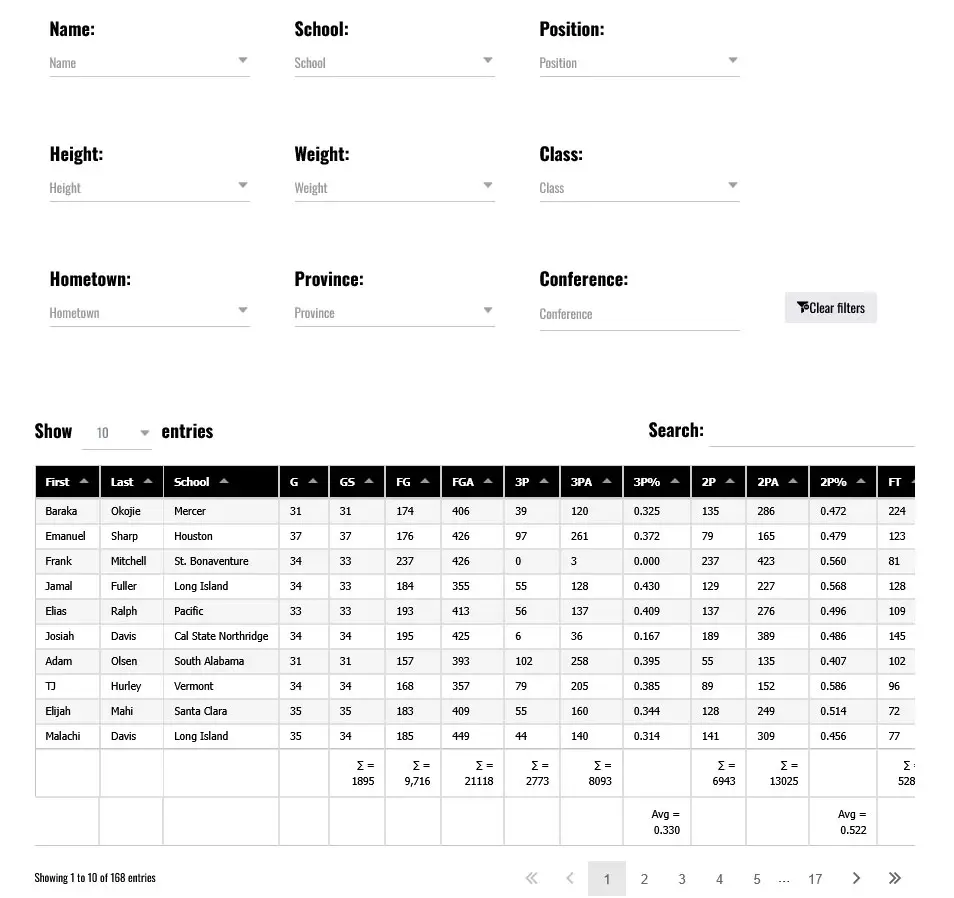

There are 168 Canadians competing in Division I this season. Some will hear their names called in June. Others will build careers across the international game. Either way, Canada’s influence within the modern NCAA ecosystem is no longer emerging. It is established.